
| Feb 1, 2026
Honing Your Second Resume After Law School
What legal hiring managers look for beyond skills and grades.
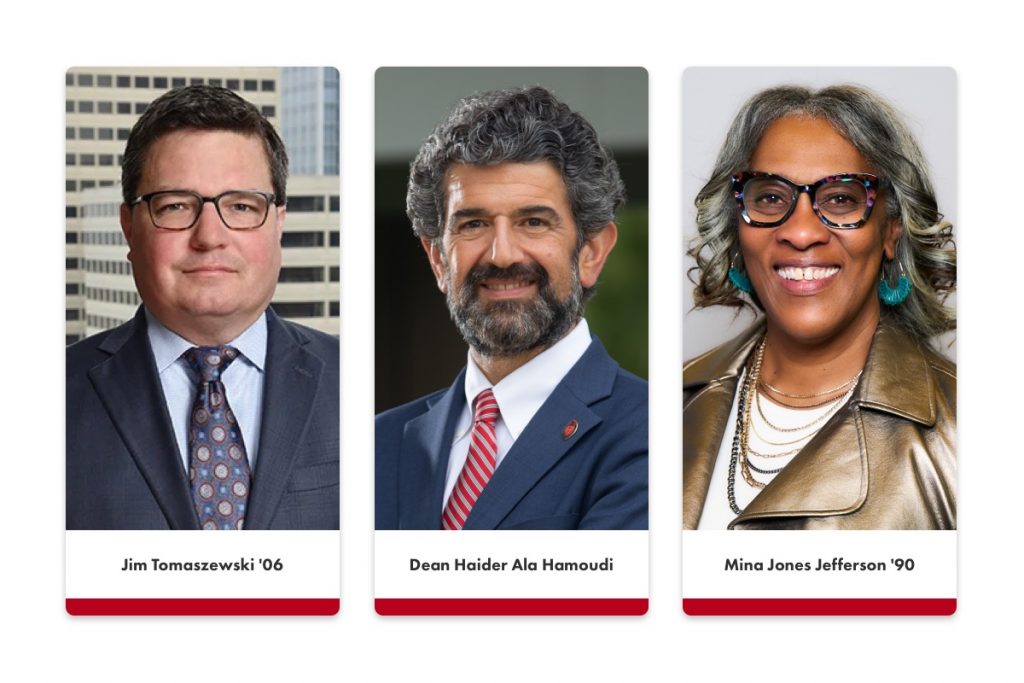
A Roundtable with Mina Jones Jefferson ’90, Jim Tomaszewski ’06, and Dean Haider Ala Hamoudi
Law school demands that you absorb plenty: torts, contracts, case law, rules for argument construction, and bluebook formatting. And then there are things you can only learn by actually showing up, responding under pressure, sometimes getting it wrong, and adapting on the fly.
We gathered three legal professionals who have spent time on both sides of that gap—as students, practitioners, and now as leaders who hire, mentor, and shape the next generation of law graduates. Our conversation ranged from first-week stumbles to the qualities that separate lawyers who thrive and evolve for the long haul. In short, what really prepares someone for a life in law.
Mina Jones Jefferson ’90 is the former Chief Culture & Engagement Officer at Bricker Graydon Wyatt LLP. She’s a former litigation partner. She served as Associate Dean and Director of the Center for Professional Development at UC Donald P. Klekamp College of Law, where she created landmark programs—including First Look—that redefined how students access and understand the legal job market.
Jim Tomaszewski ’06 serves as Director of Recruiting and Associate Advancement at Taft. He’s a former Director of Professional Development at UC Klekamp Law. He practiced civil litigation before dedicating his career to bringing students and the profession together.
Dean Haider Ala Hamoudi became Dean of the University of Cincinnati Donald P. Klekamp College of Law in 2023. Under his leadership, the College has seen JD applications rise more than 50%, enjoyed bar passage and employment rates that rank among the best in Ohio, and undertaken a wholesale reimagining of the curriculum to better integrate doctrine, professional skills, and client-centered practice from day one through graduation.
1. Think back to your first real legal job. What did you walk in not knowing that you wish someone had told you?
Mina Jefferson: I started practice believing my career was mine to manage—and within three weeks, that was confirmed. The challenge was figuring out how to act on it. I was assigned to a massive document review project that required me to work off-site for 8 hours a day. Which meant I had limited exposure to the people and work happening back at the firm. I knew I had to hustle back to the office at the end of each day and reconnect with colleagues, because exposure and relationships were what would generate more meaningful work. No one handed me that insight. I had to arrive at it quickly.
Jim Tomaszewski: My first six months were notable for their lack of “aha” moments, honestly. I had come from another career, so I understood what it meant to be a professional—but I hadn’t developed any real sense of what the actual work of being a lawyer required. What do you do when you come in each morning? What are the expectations at a mid-sized law firm? Coming from a business background, I was used to concrete performance metrics. That’s not how it works as a young lawyer. You put your head down, do the research, draft the memo, and then find out much later whether you succeeded. That feedback loop felt very long to me at first.
Dean Hamoudi: For me, the central revelation was how much of the profession runs on teamwork. Law school, when I was a student, was fundamentally an individual sport—you came to class, submitted your exam, and were graded relative to your peers. When I joined the firm, I realized almost immediately that I had to call on a completely different set of skills—things I’d honestly learned more from high school and college football than from law school. Roles, interdependencies, and the idea that you sometimes have to subordinate your individual performance for the good of the team. That’s how a high-functioning team actually operates.
2. Mina, you’ve talked about “hiring for disposition, then training for skill.” What does that mean in practice—and what are you actually looking for when you sit across from a candidate?
Mina Jefferson: The phrase comes from a simple observation: technical skill can be taught far more reliably than character can. Lawyers work with and through others. Judgment, initiative, resourcefulness, and communication—these are the things that determine whether someone thrives in a specific environment. The problem is that many firms haven’t taken the time to name those qualities and build them into their hiring processes. What I’d encourage organizations to do is look at the people who have succeeded and stayed—identify the common denominators—and then design a process that actually tests for those things, rather than relying on a general sense of “fit,” which tends to be both imprecise and prone to bias.
I’ll give you a concrete example of what it looks like when you trust disposition over credentials. A student came to my attention when I was at the firm: second-year at a top-25 law school, HBCU undergrad, 3.1 GPA. Technically outside our normal recruiting range. But I had the opportunity to interact with her, and I could see that she had the disposition—the drive, the judgment, the emotional intelligence—that I knew we could build a career around. She got an offer, came on board, and has gone on to have an extraordinary career. That story stays with me because it’s a reminder of what you miss when you only look at the numbers.
Jim Tomaszewski: I think about enthusiasm—genuine enthusiasm—as a signal that’s more durable than it gets credit for. I remember an associate here who came into my office when they were still a student, after getting her offer to join Taft as a summer associate. She was so genuinely excited, so humble and grateful for the opportunity, that I still think about it. We met up just recently, and I told her I still remember that attitude. That quality—showing up with real investment and gratitude—it’s meaningful, and it’s one of the first things I look for.
3. Dean Hamoudi, you’ve described civil discourse as a core competency—the ability to engage seriously and respectfully with people you deeply disagree with. Why does that belong on a list next to things like research and writing?
Dean Hamoudi: Because you cannot solve problems with words if you are unwilling to understand the other side’s position as they understand it — not as you wish to caricature it, but as they actually hold it. That does not mean validating every position, and it certainly does not mean treating all positions as morally equivalent. It means that effective advocacy requires disciplined understanding. If you cannot describe the other side’s argument accurately, you are much less likely to defeat it, persuade against it, or move anyone who does not already agree with you.
Many in our society have difficulty doing that, and our students are no exception. The instinct, when confronted with a position they find offensive or threatening, is to disengage or dismiss. The problem is that disengagement doesn’t resolve anything. It doesn’t win the case. It doesn’t close the deal. It does not change the institution.
I often think about Judge Constance Baker Motley, for whom I clerked. She was litigating desegregation cases in the South in the 1960s as a Black woman, facing people and institutions committed to denying equal dignity and equal rights. She did not succeed by refusing to engage them. She succeeded by understanding the arguments, the systems, the pressure points, and the institutions well enough to dismantle them through law. That is not weakness. That is advocacy at the highest level.
Mina Jefferson: Law school is actually one of the few places that invites students into that discomfort on purpose. The Socratic method, thinking like a lawyer, holding two opposing ideas in your head simultaneously—that’s the whole exercise. But too often today, students experience a contrary argument as something that’s being done to them rather than something they’re being asked to engage with. The work that happens in law school on this is not just academic preparation. It shapes the next generation of professionals and how they function in every workplace they enter.
4. Jim, you’ve said “agility” is the word you come back to most often when talking to young lawyers. What do you mean by it, and why does it matter so much early in a career?
Jim Tomaszewski: Agility is the skill that lets you manage the reality of the job, which might be nothing like what you imagined. As a young associate, you might have five projects on your desk for five different partners with five different personalities, five different working styles, and five different expectations. Agility is what allows you to move between those contexts without losing your footing. It’s also what you need when something unexpected happens—which is a daily occurrence in legal practice. And it’s what allows you to take in feedback from someone whose delivery style may be more direct than you prefer, and still be responsive.
I’d add that part of what I try to do with associates is just be candid about the demands of the job—things that don’t necessarily show up during a summer associate program, which tends to be a more relaxed version of what associate life actually looks like. We check email on weekends. There are nights when a client needs something, and you respond. Associates who find that out for the first time after they’ve started the job are at a disadvantage. I’d rather they go in with their eyes open.
5. Talk about failure. All three of you work with young lawyers navigating their first serious professional mistakes. What do you tell them—and what from your own experience do you draw on?
Jim Tomaszewski: I was a litigator working on a case heading to trial. My job, which I knew but had to learn the hard way, was to know that file backward and forwards. During a deposition, opposing counsel asked about a specific lab value from five in the morning on a particular date—something totally obscure—and I didn’t know it. It didn’t go well. And the partner I was working for was not shy about using his outside voice inside the office. What I heard was hard to take in the moment, but he wasn’t wrong. I should have known that file cold. I never forgot it. The lesson wasn’t just about preparation—it was about understanding what “ready” actually means in practice, not in theory.
When I’m talking to a young attorney who’s just made a significant mistake, I try to be honest about that story, because the point isn’t to make them feel better. The point is to show them how learning works in this profession. You are expected to fail. What distinguishes the lawyers who go on to have long careers is how they handle failure. Do they take it as feedback and adjust? Or do they get stuck in it?
Dean Hamoudi: My early example is more embarrassing than dramatic, but I think about it often. We were hosting a tailgate in my third week as dean. There were alumni in the building, the president’s office nearby, and somehow the students had a tradition of playing beer pong on the terrace. I found it completely inappropriate. So I sent a very terse email on Monday: no drinking games in this building, ever. Full stop. There were other policies announced as well, also more or less equally abruptly.
The policy was right. The delivery was not. I could have communicated the same expectation in a way that acknowledged the students, explained what we were trying to protect, and invited cooperation rather than simply announcing a prohibition. The lesson I took from it — and one I try to share with young lawyers who are also learning to lead — is that being right on the substance is only part of the job. You also have to communicate in a way that people can hear, understand, and act on. That does not mean softening the standard. It means delivering it with enough context, respect, and judgment that the message actually lands.
Mina Jefferson: I think of mistakes as simply part of doing things. When you’re in the business of reimagining or innovating, you’re going to fail, and the only question is whether you fail fast enough to learn and move on. I’ve had plenty of moments where someone used their outside voice with me. What I’ve come to believe is that the people who succeed over the long run are the ones who can take feedback and operationalize it—not just hear it, not just absorb it emotionally, but actually change their behavior in response. That is a skill. It’s related to resilience, but it’s more specific. Resilience just means you bounce back. What I’m describing is that you bounce back and you’re better.
6. There’s a phenomenon sometimes called “the shift”—students who enter law school intending to pursue public service, then get strong grades and find themselves pulled toward large firms by the difference in salary. What do you say to a student standing at that fork?
Jim Tomaszewski: It’s real, and it happens more than people talk about. You come in committed to public interest work. You have a 4.0 in the first semester. Suddenly, you have options you didn’t expect, including offers that pay two or three times what a public defender’s office would. And those financial realities are not trivial—student debt, family expectations, uncertainty about what you actually want. The decisions students make in that moment don’t always serve their long-term happiness.
What I’d say to that student is: focus on the work itself, not the name or the salary category. What will you actually be doing each day? Does it require the skills you have? Will it ask more of you than you currently have to give? Does it connect to something you care about? Those questions tend to produce clearer answers than the prestige-versus-mission framing that often gets imposed on the decision.
Mina Jefferson: Law school should be a destination, not a default. If you arrived because you didn’t know what else to do, or because you did well on the LSAT and someone suggested it, you’re already starting behind. And the question of where to go after law school is harder to answer honestly when you haven’t been honest with yourself about why you came. What I’d push students to ask is: forget what the job is called—what does it do? What does the day actually look like? What’s the work? When you approach the question from that angle, the legal profession opens up in ways that aren’t visible if you’re just trying to pick a lane from a predetermined menu.
7. If you could tell every first-year law student one thing they are almost certainly underestimating about what it takes to succeed, what would it be?
Mina Jefferson: Exposure is everything, and it doesn’t happen to you—you have to engineer it. There will be moments in your career, especially early on, when circumstances limit your visibility. A long document review project. An off-site assignment. A practice group that keeps to itself. It’s in those moments that you have to decide whether you’re going to let the circumstances define your trajectory, or whether you’re going to be the person who hustles back to the office, maintains the relationships, and keeps your presence felt. Your career is yours to manage. No one is going to do it for you.
Jim Tomaszewski: Know what the job is before you take it. That sounds obvious, but most students don’t really know, because they’ve never seen it from the inside. Use every resource available to you—mentors, externships, First Look, informational conversations—to understand not just the prestige or the salary, but the actual daily texture of the work and the lifestyle it asks of you. The students who are most agile, most resilient, most capable of navigating the profession are usually the ones who went in knowing what they were getting into.
Dean Hamoudi: Listen with the intent to understand. Not to wait for the other person to stop talking so you can demolish their argument. Not to form your response while they’re still in the middle of a sentence. Actually, try to understand what they’re saying, as they mean it. That is a legal skill, a negotiating skill, a leadership skill, and a basic human skill—and it is far rarer than it should be. If you can genuinely do it, you will be a more effective advocate, a more trustworthy colleague, and a more capable human being. It is also, not coincidentally, the foundation of everything else we’ve talked about today.
Mina Jones Jefferson ’98 is Chief People Officer at Graydon Law. Jim Tomaszewski ’02 is Director of Recruiting and Associate Advancement at Taft. Dean Haider Ala Hamoudi is Dean of the University of Cincinnati College of Law. Learn more about the College at law.uc.edu.