
| Mar 1, 2026
On Pursuing the Corporate Legal Career You Didn’t Necessarily Plan For
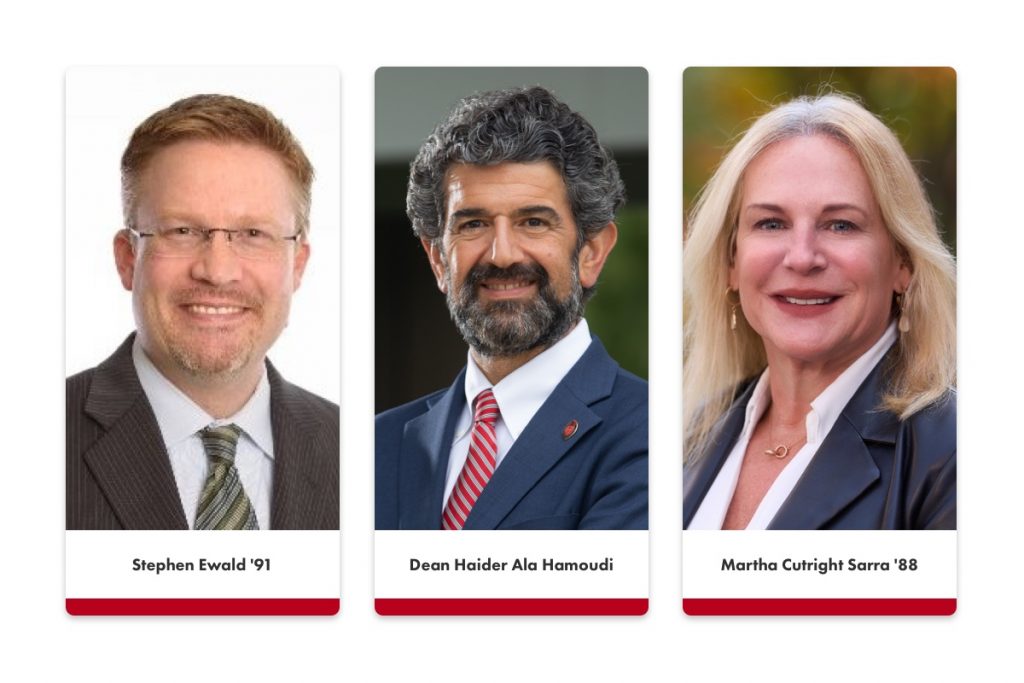
A Roundtable conversation with Martha Cutright Sarra ’88, Stephen Ewald ’91, and Dean Haider Ala Hamoudi
Martha Cutright Sarra ’88 recently retired after 27 years at The Kroger Co., where she served as Vice President and Chief Ethics and Compliance Officer. A third-generation UC Law graduate—and now a fourth-generation family, with her son John a 2016 alumnus—she serves on the Dean’s Advisory Board and remains one of the College’s most engaged alumni voices.
Stephen Ewald ’91 is General Counsel, Chief Compliance Officer, and Corporate Secretary at Medpace, a global clinical research organization headquartered in Cincinnati. He has been with the company through its growth from a private firm to a major publicly traded entity and has helped shape its campus, legal infrastructure, and culture.
Dean Haider Ala Hamoudi became Dean of the University of Cincinnati Donald P. Klekamp College of Law in 2023. Under his leadership, the College has seen JD applications rise more than 50%, enjoyed bar passage and employment rates that rank among the best in Ohio, and undertaken a wholesale reimagining of the curriculum to better integrate doctrine, professional skills, and client-centered practice from day one through graduation.
The first roundtable in this series drew on perspectives from the firm environment, the associate track, and the long arc from first-year to partner.
But not every legal career runs through a firm. This installment addresses the question of which legal path best fits you from a different angle.
Martha Cutright Sarra spent 27 years at Kroger. Steve Ewald has spent more than a decade as general counsel at Medpace. Neither of them bills by the hour nor manages a client roster. What they do, day to day, is advise businesses from the inside.
Their individual and collective experience reminds us that some of the most consequential legal work happening in Cincinnati — and across corporate America — is being done by lawyers who work inside companies, embedded in the business, responsible for helping it move rather than just advising it from a distance.
It’s a different kind of practice, and it asks for a different kind of lawyer.
In-house counsel teams face different pressures and sustain longer-term relationships. Success often depends on helping business teams solve problems — product launches, compliance questions, supply chain disruptions, employment issues, contracts, regulatory changes, or operational crises — rather than simply identifying legal risks.
For students sorting through their options, Sarra and Ewald may help make such distinctions clearer.
1. Students tend to picture in-house counsel as lawyers who mostly manage outside firms. How does the reality compare—and why does the gap matter?
Steve Ewald: One of the first things a young UC graduate told me after joining our department was that he hadn’t realized how much hands-on work he’d actually be doing. He assumed we mostly coordinated outside counsel. That gap between expectation and reality matters because students who come in prepared for the actual work—drafting, advising, making judgment calls in real time—hit the ground running. Those who expect to manage at arm’s length spend their first months reorienting.
The honest picture: we insource as much real legal work as we can. Outside counsel serves as an escape valve for specialty situations. That’s true at more and more companies. In-house departments have grown substantially over the past few decades, and corporations have come to value their internal lawyers as strategic partners—not just as compliance traffic cops.
Martha Sarra: I started at LexisNexis two years out of law school, and my initial job was about as narrow as it gets: negotiating subscription agreements with law firms. It was a three-page form contract, and it barely moved. But I was sitting across the table from partners at law firms, working through every clause, and I was learning how to hold my ground in a negotiation. After a couple of years, I’d systematized what I could, brought in paralegals to handle the routine pieces, and started looking for what was next. I wasn’t told to do any of that. I just knew that doing one thing well wasn’t going to be enough.
Dean Hamoudi: What Steve and Martha are really describing is the difference between a lawyer who understands what the client is trying to accomplish and one who only evaluates whether a given action creates risk. Those are different lawyers. The second kind tends to become invisible—or worse, avoided—because nobody wants to consult with someone whose default answer is no. The first kind becomes indispensable. We spend a lot of time at the College making sure students understand that distinction before they ever walk into their first job.
2. The legal profession has been shifting toward in-house for decades. What does that mean for a student who’s weighing firm versus corporate?
Steve Ewald: When I started, going in-house right out of law school was genuinely unusual. Most corporate departments wanted partners—people with seven or more years of experience who could arrive already formed. That’s changed. We now bring in junior lawyers, and the fellowship and externship programs UC runs are a significant part of how that works. They give us a low-stakes way to see how someone actually functions in our environment before either side commits. And they give students something you can’t replicate in a classroom: real exposure to the day-to-day texture of a corporate legal department.
Martha Sarra: When I joined, Kroger’s interview bar was a 7-year minimum. I came in at a senior level because that was what they needed. But the environment has shifted, and there’s a genuine opportunity now for students who want to be close to the business from the start. What I would tell them is: don’t just evaluate the title or the pay. Understand what the work actually is. Ask what a typical Tuesday looks like. Ask how much of the work is handled internally versus handed off. Ask how decisions get made, and at what level. That knowledge is what helps you walk in ready.
3. Grades still matter. But Martha, you’ve made the point that when you look back at your graduating class thirty years out, grades weren’t the most reliable predictor of who ended up where. What did matter?
Martha Sarra: The people who have built the most successful careers in my class were not the people at the very top academically. In fact, I honestly couldn’t tell you where most of those people ended up—a number of them aren’t even practicing anymore. The people who thrived were the ones who were genuinely engaged. Student Bar Association. Organizations. People who showed up and were known, not because they were angling for something, but because they were curious and social and present. Social skills are at least as important as academic skills—and over a career, possibly more so. You need the intellectual foundation. You need to be able to think and give sound advice. But that foundation only carries you so far without everything else.
Steve Ewald: I’d add that when I’m evaluating candidates, I look at course selection almost as closely as GPA. Someone with a 4.0 who took only constitutional law may be less interesting to us than a B student who loaded their schedule with corporations, business associations, and regulatory courses. That person has already demonstrated an interest in the subject matter, and they’ve started building the vocabulary they’ll actually use. It’s a continuum—not a formula.
4. What does initiative look like when you’re watching a student or a young lawyer in real time? How do you know it when you see it—and when it’s missing?
Martha Sarra: I always tell externs and fellows: my door is open, but I’m running all day. If you only answer my check-in question with “okay,” that’s often all you’ll get from me, because I’m already moving to the next thing. But if you come over at the end of the afternoon and say, “Can I run this by you? Here’s what I’ve done, here’s where I got stuck”—that changes everything. The people who ask for feedback don’t just get better feedback. They get more invested mentors. The initiative to seek out the conversation is itself part of what I’m evaluating.
Steve Ewald: From the moment someone joins our department—extern, fellow, new hire—they’re part of the team. They attend staff meetings. They have the opportunity to present to the whole group. They interact with the other lawyers and professionals in the department. And I watch carefully: not just how they handle what’s assigned to them, but what they do beyond it. Are they asking questions about the business, about the industry, about how things connect to what they’re working on? That curiosity—not curiosity directed at impressing me, but genuine interest in the work and the company—tells me a great deal about where someone will go.
Dean Hamoudi: I’ve come to believe that the single most important skill I look for is the ability to receive feedback, absorb it without being derailed by it, and deliver a better product the next time. If you do that consistently over the course of thirty years, you will have grown more than someone who started at the top of their class and couldn’t hear criticism. Grades are a data point. Coachability is a trajectory.
I had a partner who once sent back a memo I’d written with the note: *There’s literally nobody at this firm who has the time to read what you just wrote. Try again.* It stung. I remember it decades later. And it is absolutely the feedback I needed, though it was not delivered particularly kindly. I try to preserve the clarity of the substance while being more empathetic in tone when I pass along similar feedback.
5. If you could speak to your 22-year-old self about what was ahead, what would you say?
Martha Sarra: Things change constantly, and the roles that will define your career may not exist yet. There were no privacy lawyers when I started. No technology lawyers in any real sense—PCs were barely a thing. What allowed me to build something over a long career was the willingness to move into areas that were still forming, to learn things nobody else knew yet, and to stay curious when it would have been easier to stay comfortable. If I were a student today, I’d be learning everything I could about AI and privacy law, because that’s where the growth is going to be. Flexibility and curiosity—those are the actual competitive advantages. Everything else is table stakes.
Steve Ewald: I struggle to improve on that, because we came out at essentially the same time and had almost identical experiences. I’d probably tell myself to listen more and talk less—a lesson I’m still working on. But the deeper thing is: don’t be content. I never felt stuck anywhere, because I was always looking for the next layer of the work. Advancement came as a result of that, but advancement wasn’t the point. The point was to become a better practitioner.
And I’ll say this: I am sitting in a role today that I never could have imagined for myself when I graduated, or when I took my first job, or when I left the firm to go in-house. I do something very different than I expected. The career I have is a product of taking the opportunities that came and making the most of them—not of executing a plan I designed at 25. When I interview candidates and ask them where they want to be in twenty years, I’m not looking for a roadmap. I’m actually more interested in the people who say, “I have no idea, but I hope I’m X, Y, and Z.” That tells me something real. The person who has it all scripted—I find that a little worrying. Not because ambition is a problem, but because that certainty usually isn’t honest.
6. Dean Hamoudi, you’ve talked about the anxiety you see in current students—especially the tendency to over-program their paths and treat any setback as a crisis. What do you want them to hear from Steve and Martha’s experience?
Dean Hamoudi: I think what strikes me most about what they’ve described is the degree to which their careers were built on contingency. On opportunities they hadn’t predicted, on skills they developed in response to what the moment required, on the willingness to say yes to things that weren’t quite what they’d planned. That’s almost the opposite of what many students under pressure believe they need to do, which is to have every branch of the decision tree mapped out by the second year.
The anxiety is real, and I want to take it seriously rather than dismiss it. This is a generation that has absorbed a great deal of uncertainty—COVID, political volatility, economic instability. The instinct to over-control the future makes sense as a response to that. But the irony is that the over-programming tends to work against them. A B-minus in torts becomes a catastrophe. A summer that doesn’t go exactly as planned becomes evidence of failure. And in the meantime, the skills that will actually sustain a thirty-year career—curiosity, adaptability, the willingness to engage with the unexpected—are going undeveloped.
7. You’ve both talked about civil discourse as something the profession depends on—the ability to hold two opposing positions in your mind at once and argue both with rigor. How did that capacity get built in you, and what do you say to students who find it difficult?
Martha Sarra: I go back to my first-year contracts class. The professor would assign us positions at random. You’d read the case one way, decide it was clear, and then be called on to argue the other side. And you’d start, reluctantly, to find the arguments—and realize they were actually there. That exercise taught me something I’ve used every day since: it is rarely as clear as you think. The ability to represent both sides fairly, to actually inhabit the logic of the position you disagree with, is what separates a lawyer who can navigate real complexity from one who can only handle the cases where the answer confirms what they already believed.
Steve Ewald: Be passionate, but not emotional. Those are not the same thing. Passion means you care about the outcome and you’ll fight hard for it. Emotion means the argument has become about you rather than the question. The first is an asset in any room. The second usually isn’t. What I’d say to students is: approach every disagreement wanting to understand what you might have wrong. Listen not to confirm your position, but to find its limits. You don’t have to surrender it. But if you’ve genuinely understood the other side, your argument for your own position will be sharper for it.
And we had professors in law school—this was the early nineties, so the political environment was different, but there were still genuinely controversial issues—who came from very different points of view. My study group was politically diverse. We all got A’s. Because what was being graded was the rigor of the analysis, not the conclusion. That’s what good legal education looks like, and I think UC still does it.
8. Last question: each of you has described, one way or another, the experience of looking back and feeling like the work mattered. What’s the image that comes to mind when you think about that?
Steve Ewald: I think about what it means to have been trained to do something that genuinely helps people navigate a world that’s genuinely complicated. I’ve spent a significant part of my career giving legal advice to people who needed it and couldn’t easily afford it—just as an individual, not in any formal capacity. Real advice, where I’m actually taking on some risk. Because I was given a good education that made me useful, and that usefulness doesn’t only belong in the billable context. It belongs to anyone who needs it.
One of the people I met the very first week of law school—we were in the same section, went through three years of it together—is now my number two at Medpace. We’ve been friends for over thirty years. My entire study group is still in my life. That’s not an accident of affection. That’s what it means to go through something hard together in a place small enough that you can’t be anonymous. The rigor built the bonds. That’s part of what I’d want students to understand about a school this size: the connections you form here will outlast everything else.
Martha Sarra: My grandfather graduated from UC Law in 1924. My father graduated in 1959. I graduated in 1988. My son graduated in 2016. When we talk about what this school has meant to our family, it’s not abstract. It’s four generations of people who came here, were challenged, were shaped, and went out and built something with what they learned. The trial courtroom in the new building bears my father’s name—Judge David Alan Cutright—because he believed, more deeply than almost anything else, that an education was the most important gift you could give someone. He told me he would support whatever path I chose, law school or medical school, because he wanted me to pursue my education without carrying the weight of how I was going to pay for it. His words were: *My gift to you is an education.* We named the courtroom for him because that belief is exactly what should be honored in a place like this—and because there are students here today who deserve that same freedom to focus on becoming who they’re going to be.
Martha Cutright Sarra ’88 is the former Vice President and Chief Ethics and Compliance Officer of The Kroger Co. Stephen Ewald ’91 is General Counsel, Chief Compliance Officer, and Corporate Secretary at Medpace. Dean Haider Ala Hamoudi is Dean of the University of Cincinnati Donald P. Klekamp College of Law. Learn more about the College at law.uc.edu.