
| Jan 1, 2026
5 Good Questions with Charlie Rittgers ’10
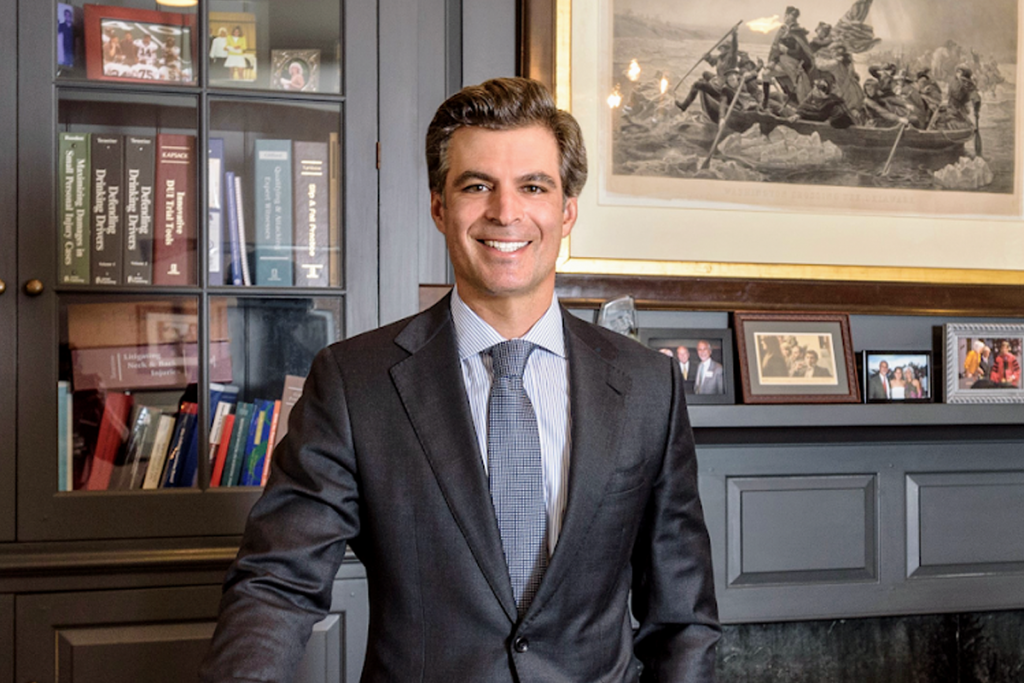
Trial law is being reshaped by forces that have nothing to do with the law itself—shrinking attention spans, large-scale behavioral data, and the growing gap between how jurors absorb information and how lawyers have been trained to deliver it. Charlie Rittgers, managing partner of Rittgers, Rittgers & Nakajima and one of Ohio’s most accomplished trial lawyers, is among an emerging group of litigators rethinking their craft in response. We asked him what that adaptation actually looks like—from the data he’s collecting long before a trial begins, to the way he puts a witness on the stand.
1. When you’re preparing for trial, what does readiness look like—and how does early preparation change the way you walk into the courtroom?
The best trial lawyers, no matter how well-prepared, always feel like there’s more they could have done. That’s actually a good sign. If what you see in the courtroom looks smooth and spontaneous, it’s highly likely that the lawyer has practiced 99% of what comes out of their mouth 30, 40, or even 100 times before they ever stood up.
I grew up hearing my dad say you can truly never be overprepared for trial—and I believe that. The worst thing you can do is walk in thinking you’re ready when you’re not. The best thing you can do is be the most prepared person in the room and still want more time.
2. You use large-scale jury focus groups to gather insights. What has that approach taught you that your gut could not?
In my first decade, I really trusted my intuition. But the large data sets have humbled me. There are a decent number of occasions where what I thought was true was just flat wrong.
Take a case where I was convinced that a juror’s position on abortion would significantly shape how they viewed the facts. I focus-grouped that issue four times. Every time, I was wrong. It didn’t matter. And because I knew that going in, I didn’t waste a single question in voir dire (pronounced vwah-deer/jury selection) on it—especially when the judge put a time limit on us.
Without that data, I’d have been wasting time on something irrelevant and raising my own anxiety for no reason. The larger the group, the clearer the signal. Eight people can mislead you. Five hundred people reveal patterns you can actually trust.
3. How has working with large data sets changed how you prepare and evaluate witnesses?
I’ve played witness clips—ten minutes from a deposition—for hundreds of online focus group participants and watched their responses. I’ve also brought clients into a room of eight strangers and had someone cross-examine them live.
Today’s jurors have genuinely shortened attention spans, shaped by short-form video and social media. As a trial lawyer, I don’t think the profession has caught up.
So we practice what I call speed trials: get a witness on the stand, cover three things—who are you, why are you here, what do you know—and get off in five minutes. The jury wants the trailer, not the movie. The fastest, clearest witness often does more for your client than an hour of exhaustive testimony.
4. How do you think about your opponent’s strategy while preparing your own?
One of the first things I do when I’m stuck—whether on an opening, a brief, or witness prep—is write down what I call the “I can’t get over it” facts. I do that for my case and for my opponent’s. Usually two to five things on each side, sometimes ten. Those are the facts the jury is actually going to be talking about in the deliberation room, buried under two weeks of noise. Everything else is detail.
And the only way to run an honest adversarial focus group is to advocate as hard for the other side as they’ll advocate for themselves—otherwise your results are worthless. You have to know what scares you, and then you have to say it out loud to the jury first.
Credibility is everything. Jurors are skeptical of lawyers on both sides from the moment they walk in. The lawyer who wins is usually the most prepared—but just as important, they’re the most credible. That means being brutally honest about your own vulnerabilities.
5. What advice do you give young lawyers—or law students—who want to develop effective communication skills?
People always ask me whether a mock trial or a moot court is the path. And those can help. But I’d put a greater premium on someone who waited tables, tended bar, or drove Uber—someone who had to read strangers quickly, hold short conversations across every walk of life, and stay calm under pressure. That’s actually very close to what trial work demands.
If you’re in law school right now and you want to practice, put your phone away during your next Uber ride and give the driver a three-minute version of a case you’re studying. See if you can explain it simply.
Simple language wins in the courtroom. Lawyers tend to write and speak in ways that are too legal, too complex. The clearer you can make something, the more persuasive you are. That skill—translating complexity into plain human language—is one you can practice anywhere, every single day.
Charlie Rittgers ’10 is managing partner of Rittgers, Rittgers & Nakajima in Cincinnati, Ohio. Learn more at rittgers.com.